
22.04.2026
Everyone is talking about AI governance. Very few organisations actually know what it looks like in practice.
So what is an AI Governance Programme?
It’s not a single policy.
It’s not a checklist.
And it’s definitely not just a compliance exercise.
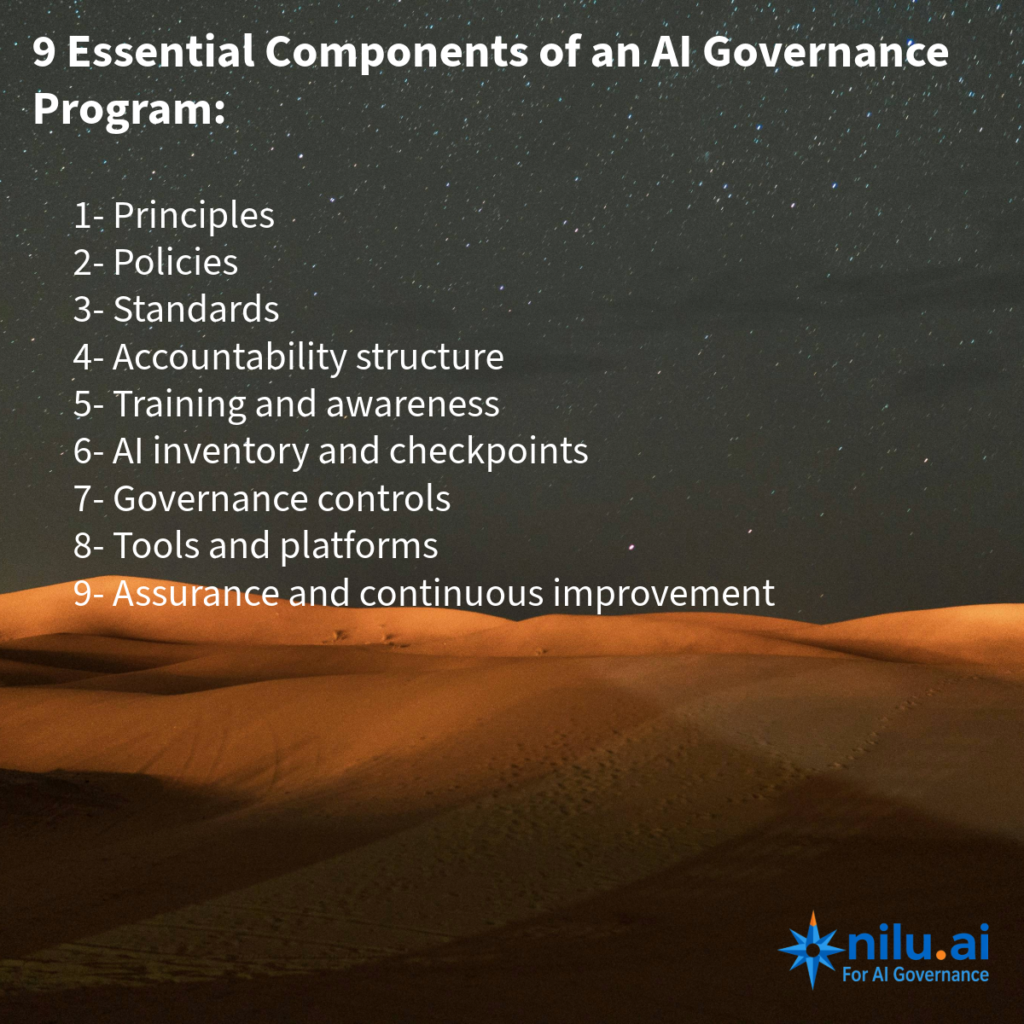
A proper AI Governance Programme brings structure across the entire AI lifecycle. At a minimum, it should cover these 9 components:
- Clear principles (what the organisation stands for when using AI)
- Policies and standards (what must be followed)
- Defined accountability (who owns AI risks and decisions)
- Training and awareness (ensuring people understand how to use AI responsibly)
- AI inventory and use case visibility (what AI systems exist and where they are used)
- Risk and impact assessments (evaluating risks before deployment and during use)
- Controls embedded into development and usage (ensuring AI is governed in practice, not just on paper)
- Tools and platforms (supporting governance through systems, workflows, and automation)
- Monitoring, assurance, and continuous improvement (ensuring AI remains compliant, effective, and trusted over time)
Without this structure, AI becomes unpredictable, unmanaged, and difficult to trust.
The organisations that are getting ahead are not waiting for regulation to force them, they are building governance as a foundation for scaling AI safely.