
Many organisations ask: “If we implement ISO/IEC 42001 properly, why do we still need the EU AI Act?” Or: “If we use NIST AI RMF, why would we also need ISO 42001?”
The answer becomes clearer through a practical example: Imagine an organisation deploys an AI system to screen and rank job applicants. This immediately creates concerns around bias, explainability, accountability, human oversight, monitoring, and regulatory exposure. Now let’s see how each framework approaches the same AI system differently.
EU AI Act — Legal & Regulatory Obligations
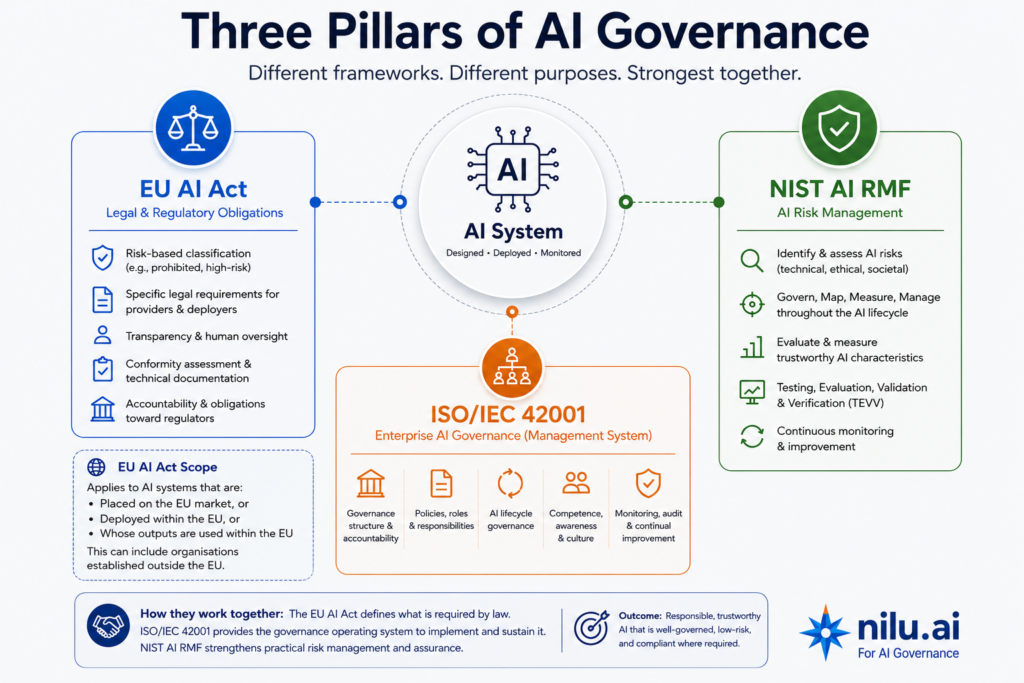
The EU AI Act is regulation. Importantly, its scope can also extend beyond Europe where AI systems are placed on the EU market or their outputs are used within the EU.
In this example, the recruitment AI system would likely be considered a “high-risk AI system.” That creates obligations such as conformity assessments, technical documentation, transparency requirements, human oversight, and post-deployment monitoring. The EU AI Act therefore answers: “What must we legally do?”. However, it does not fully explain how to operationally run AI governance.
ISO/IEC 42001 — Enterprise AI Governance
This is where ISO/IEC 42001 becomes important. ISO 42001 helps organisations establish governance structures, accountability, policies and standards, lifecycle governance, supplier governance, competence and awareness, and monitoring and continual improvement. It operationalises AI governance across the enterprise and therefore answers: “How do we govern AI operationally and consistently across the organisation?”
However, another challenge still remains.
NIST AI RMF — Practical AI Risk Management
NIST AI RMF strengthens the practical side of AI risk management. It focuses heavily on identifying and assessing AI risks, trustworthy AI, measurement and monitoring, testing and validation, TEVV, and continuous risk evaluation.
NIST AI RMF therefore answers: “How do we practically assess, measure, and manage AI risks?”
Why They Work Best Together
The distinction now becomes clearer. An organisation could satisfy some EU AI Act obligations but still lack mature operational governance. Or it could implement ISO 42001 governance structures but still have weak AI risk assessment practices. Or it could perform strong NIST-style AI risk assessments but still fail regulatory obligations.
Each framework solves a different governance problem.
| Framework | Main Focus |
| EU AI Act | Legal & regulatory obligations |
| ISO/IEC 42001 | Enterprise AI governance |
| NIST AI RMF | AI risk management |
This is why mature organisations increasingly combine all three. The EU AI Act provides regulatory direction, ISO/IEC 42001 provides the governance operating model, and NIST AI RMF strengthens practical AI risk management.
Together, they create a more complete AI governance ecosystem.