
One of the most important requirements for effective AI governance is human capability (not just policies or documents or controls). People must actually understand how to work with AI responsibly. And that’s where many organisations struggle. There’s a big difference between:
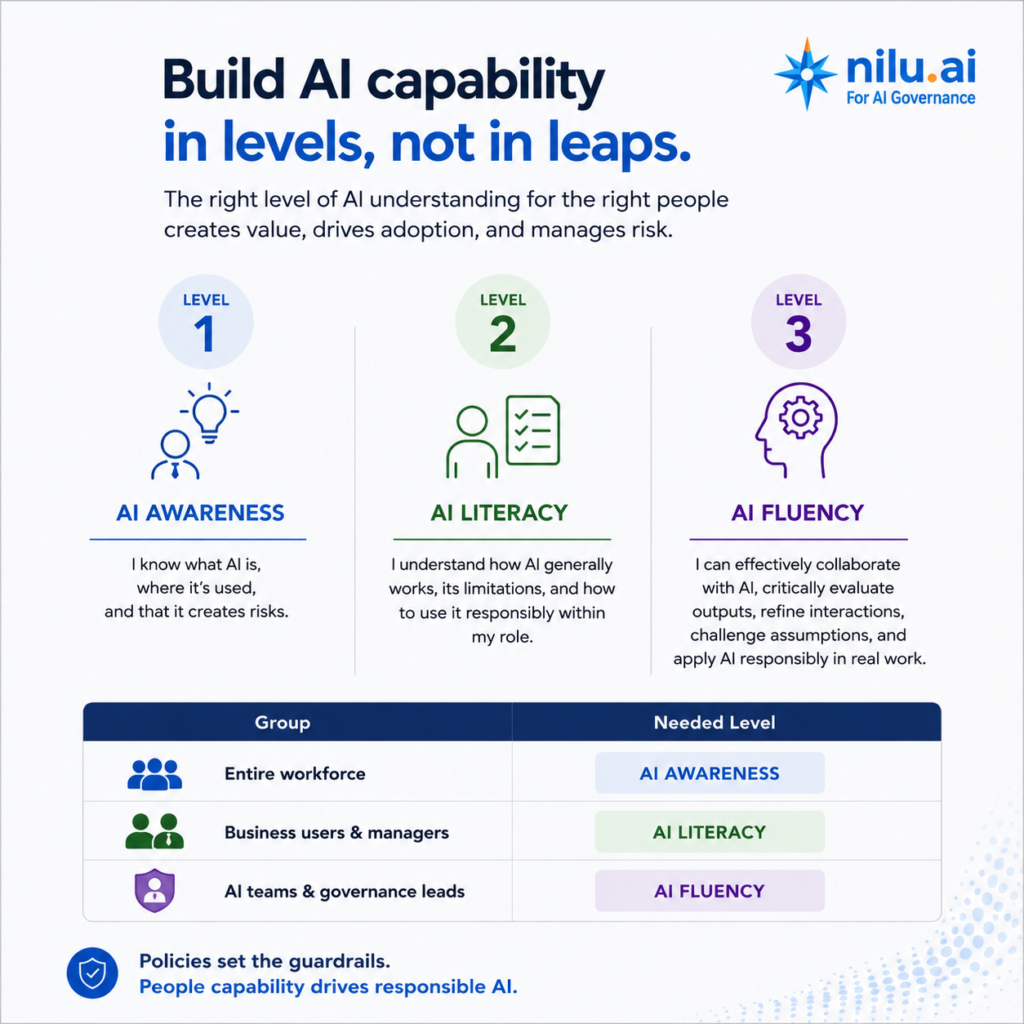
AI Awareness (level 1)
“I know what AI is, where it’s used, and that it creates risks.”
AI Literacy (level 2)
“I understand how AI generally works, its limitations, and how to use it responsibly within my role.”
AI Fluency (level 3)
“I can effectively collaborate with AI, critically evaluate outputs, refine interactions, challenge assumptions, and apply AI responsibly in real work.”
The gap between literacy and fluency is especially important. Many people can use AI tools. Far fewer can:
- challenge AI reasoning
- identify missing context
- detect hallucinations
- refine prompts iteratively
- critically evaluate polished outputs
- understand when AI should NOT be trusted
That matters because polished AI outputs often create false confidence. A mature AI governance programme develops capability progressively:
Entire workforce → AI Awareness
Business users & managers → AI Literacy
AI teams & governance leads → AI Fluency
Without that foundation, organisations risk:
- blind trust in AI outputs
- unsafe AI usage
- weak human oversight
- poor decision-making
- unmanaged AI risks
AI governance is not only about governing AI systems. It is also about developing people who can govern and work with AI responsibly.